

SEARCH EXPERIENCE OPTIMIZATION What is SXO (Search Experience Optimization)?
SXO (Search Experience Optimization) is the targeted optimization of the user experience after the click from search – with the goal of not only attracting visitors, but convincing them and guiding them toward conversion. Search engines bring traffic. But whether users stay, continue reading, or take action depends on the quality of the experience on your website: relevance, structure, speed, and orientation. This is exactly where SXO comes in. How technical optimization and genuine user-centricity work together and why this determines your success – is what you will learn in this article.

What is Search Experience Optimization (SXO)?
Search Experience Optimization (SXO) describes a holistic approach that combines search engine optimization with user experience. The goal is to provide users with the best possible experience after they click on a search result.
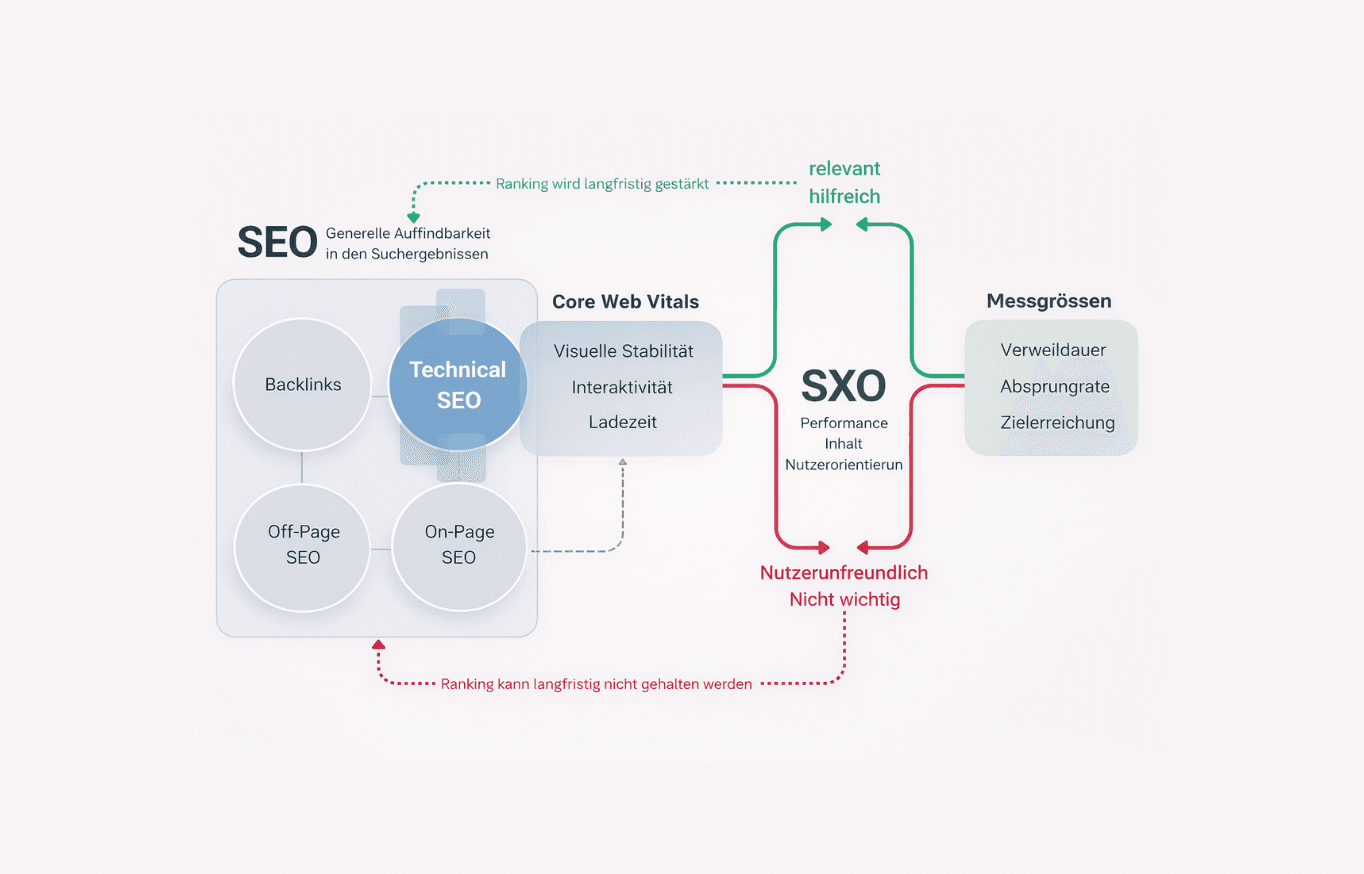
Unlike pure SEO, SXO does not stop at rankings. SXO asks whether users find what they expect, whether content is presented in a clear and understandable way, and whether they can reach their goal without unnecessary friction. Search engines evaluate these factors indirectly through user signals such as dwell time, bounce rate, and interaction behavior.
This makes SXO the link between technology, content, and human needs. It ensures that visibility also leads to user satisfaction.
How does SXO influence SEO rankings?
In addition to analyzing the content of your website, search engines also evaluate user behavior. Pages that load slowly, are difficult to navigate, or fail to meet expectations tend to lose visibility over time. SXO therefore influences SEO rankings indirectly, but in a sustainable way.
Key SXO metrics include loading speed, interactivity, and visual stability, which are summarized in the Core Web Vitals. These are complemented by dwell time, bounce rate, and goal completion. Positive user signals indicate to search engines that a page is relevant and helpful.
SXO therefore helps maintain strong rankings over the long term. It connects performance, content, and user focus into a stable quality factor.
What are best practices for SXO?
Successful SXO emerges where technical performance and user needs come together. One of the most important foundations is a mobile-first design. Content must load quickly on mobile devices, be easy to read, and function smoothly.
Equally important is a clear information architecture. Users should immediately understand where they are and how to reach their goal. Short paragraphs, clear headings, and logically structured content reduce cognitive load and increase dwell time.
From a technical perspective, the so-called Core Web Vitals play a central role. Fast load times, stable layouts, and responsive interactions build trust. In addition, a clear alignment with search intent ensures that content delivers exactly what users expect.
What are Core Web Vitals?
Core Web Vitals are metrics defined by Google to evaluate user experience on websites. They measure how fast, stable, and responsive a page is for users:
Largest Contentful Paint (LCP): loading time of the main content
Interaction to Next Paint (INP): responsiveness to user interactions
Cumulative Layout Shift (CLS): visual stability during loading
Good Core Web Vitals improve user experience and have an indirect positive impact on rankings, dwell time, and conversion rates.
Common mistakes with Core Web Vitals
Many websites lose SXO potential due to avoidable issues:
Oversized images without optimized formats or lazy loading
Blocking JavaScript that delays interactions
Layout shifts caused by content loading later or missing placeholders
Too many external scripts, such as tracking tools or widgets
Poor mobile performance, even though the majority of traffic comes from mobile devices
These issues degrade the user experience and lead to higher bounce rates. SXO connects technical optimization with true user focus.
SXO vs. SEO: Where should the priority lie?
SEO and SXO are not in competition. SEO creates visibility; SXO creates impact. Without SEO, users won’t find the website. Without SXO, they won’t stay.
In terms of prioritization, SEO is often the entry point, while SXO represents the next stage of development. Once content is ranking, user experience determines whether those rankings remain stable and whether conversions occur. Search engines recognize this quality through user signals and increasingly factor them into their evaluations.
In a modern strategy, SEO and SXO should therefore be planned together. Technical optimization, content, and user guidance are always interconnected. Those who optimize only for search engines waste potential. Those who focus solely on UX risk lacking visibility.
The priority, then, lies not in one approach or the other, but in the interplay between both disciplines. SXO does not mean more content – it means better content at the right time.
What role does SXO play in combination with AIO, AEO, and GEO?
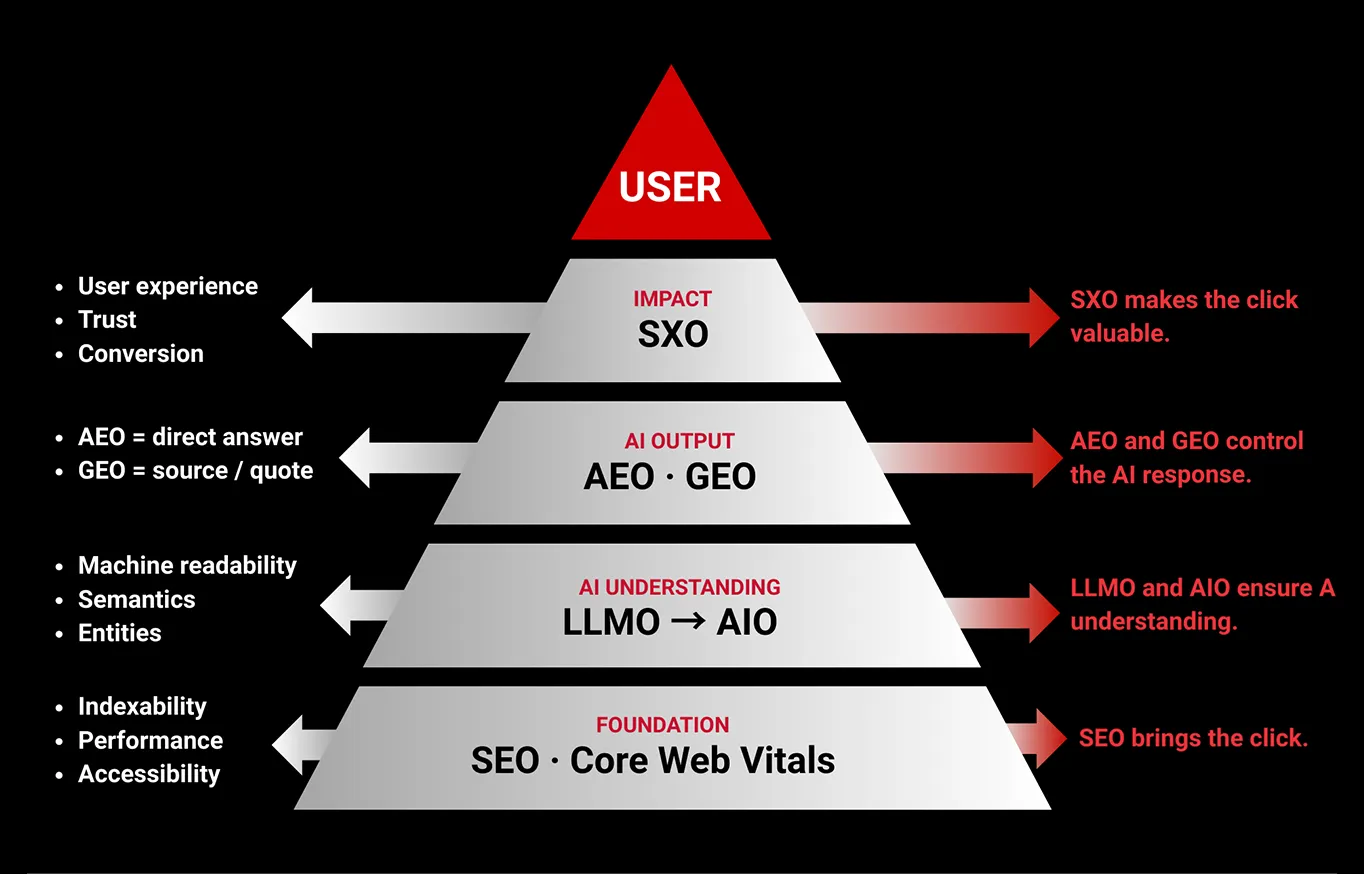
Even in an AI-driven search landscape, people still have the highest priority. SXO ensures that technical and AI-based optimizations actually deliver results once a user interacts with a website.
AIO ensures that content is understandable for AI systems and correctly classified. AEO optimizes content for direct answers. GEO aims for mentions and inclusion in AI-generated results. SXO takes over the crucial step afterward: it ensures that users stay, understand, and take action.
If a website is recommended or cited by AI systems but offers a poor user experience, a disconnect occurs. Users leave the site quickly. These signals then affect search engine evaluations as well and weaken visibility over time.
SXO therefore connects machine optimization with human expectations. It ensures that clicks do not fizzle out, but instead lead to trust, interaction, and conversions. In a holistic strategy, SXO is not an add-on – it is the prerequisite that allows AIO, AEO, and GEO to succeed sustainably.
SXO – Visibility with impact
SXO connects visibility with impact. Rankings bring users to a website, but only a compelling user experience determines dwell time, trust, and conversion. SXO ensures that content is not only seen, but also understood and used.
Even in an AI-driven search landscape, SXO creates the link between technical optimization, AI visibility, and human expectations. Anyone who strategically applies SEO, AIO, AEO, and GEO needs SXO to ensure that every click delivers real value.
Do you want visitors to stay on your website instead of bouncing – and to take action? Or are you looking for support in combining SEO, UX, and performance into a holistic SXO strategy? We help you turn search results into real user experiences and conversions.
Better user experiences?
Talk to us about SXO and sustainable conversion. Get in touch now for a no-obligation conversation.


Spannende Themen für dich!