

SEO vs. AEO vs. GEO What is the difference between SEO, AEO, and GEO?
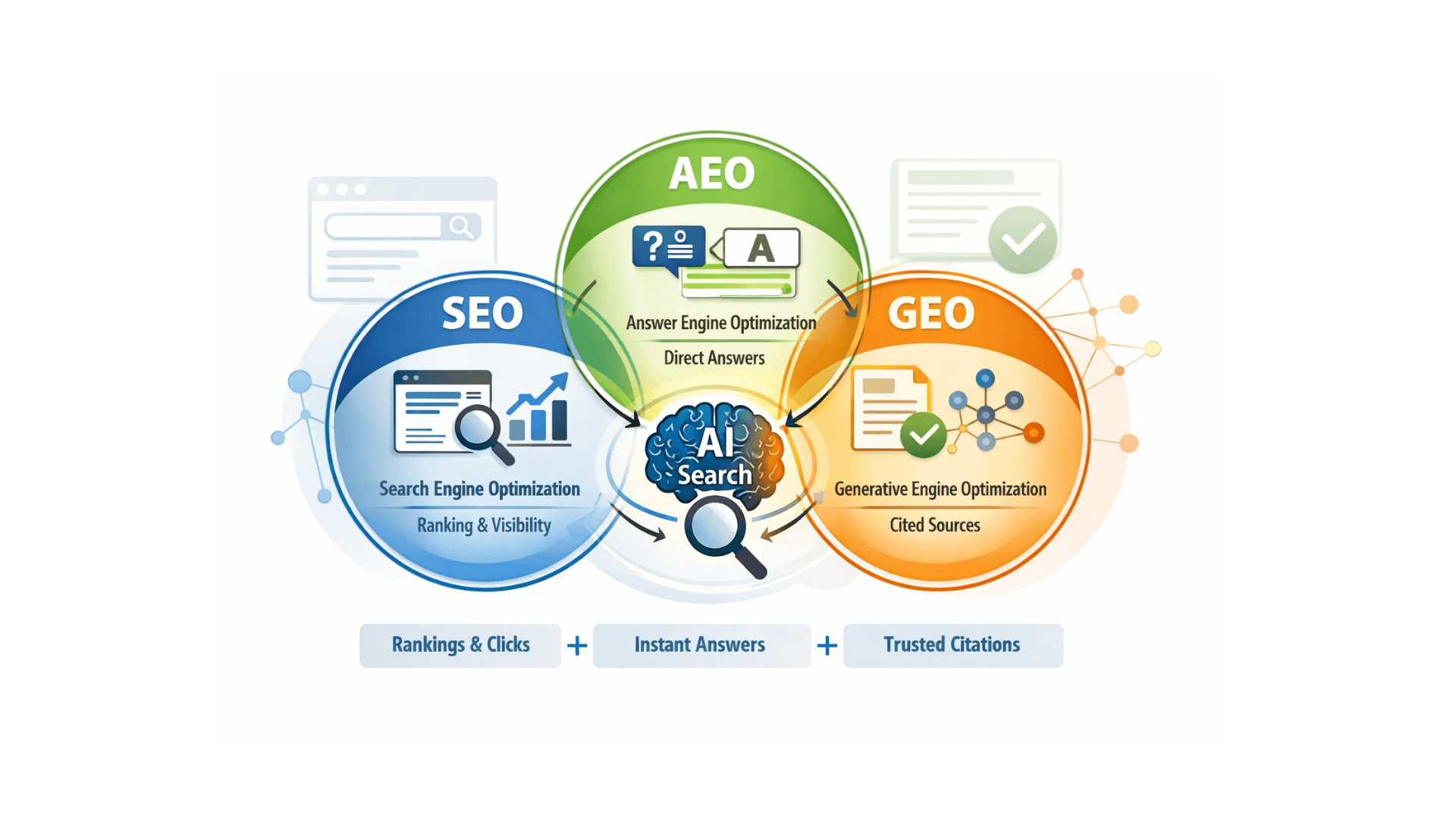
Search engine optimization has evolved dramatically in a short period of time. In addition to classic rankings, direct answers and AI-generated summaries now determine which content is visible. SEO alone is no longer sufficient for this, but it remains the foundation of every successful optimization strategy. SEO, AEO, and GEO pursue different goals and address different output channels, but they complement each other. Anyone who wants to build sustainable visibility must therefore learn how these disciplines interact and what role they play in the modern search ecosystem.
- What is SEO and what is its objective?
- What is AEO and how does it differ from SEO?
- What is GEO and what role does it play in comparison?
- SEO, AEO, and GEO compared directly
- How are AI systems changing traditional SEO strategies?
- Do I still need SEO if I focus on AEO or GEO?
- Which content formats benefit most from AEO and GEO?
- What role does E-E-A-T play in the interaction between SEO, AEO, and GEO?
- How does content planning change with AI-based search systems and the mix of SEO, AEO, and GEO?
- Conclusion
What is SEO and what goal does it pursue?
SEO (Search Engine Optimization) focuses on optimizing websites for organic search results in order to gain visibility for relevant search queries and attract qualified website traffic.
SEO optimizes content, technical foundations, and external trust signals to make websites understandable, accessible, and evaluable for search engines. Core factors include semantic relevance, performance, structure, and authority. Even in the age of AI, SEO remains essential, as it forms the foundation for the indexing, interpretation, and discoverability of content.
What is AEO and how does it differ from SEO?
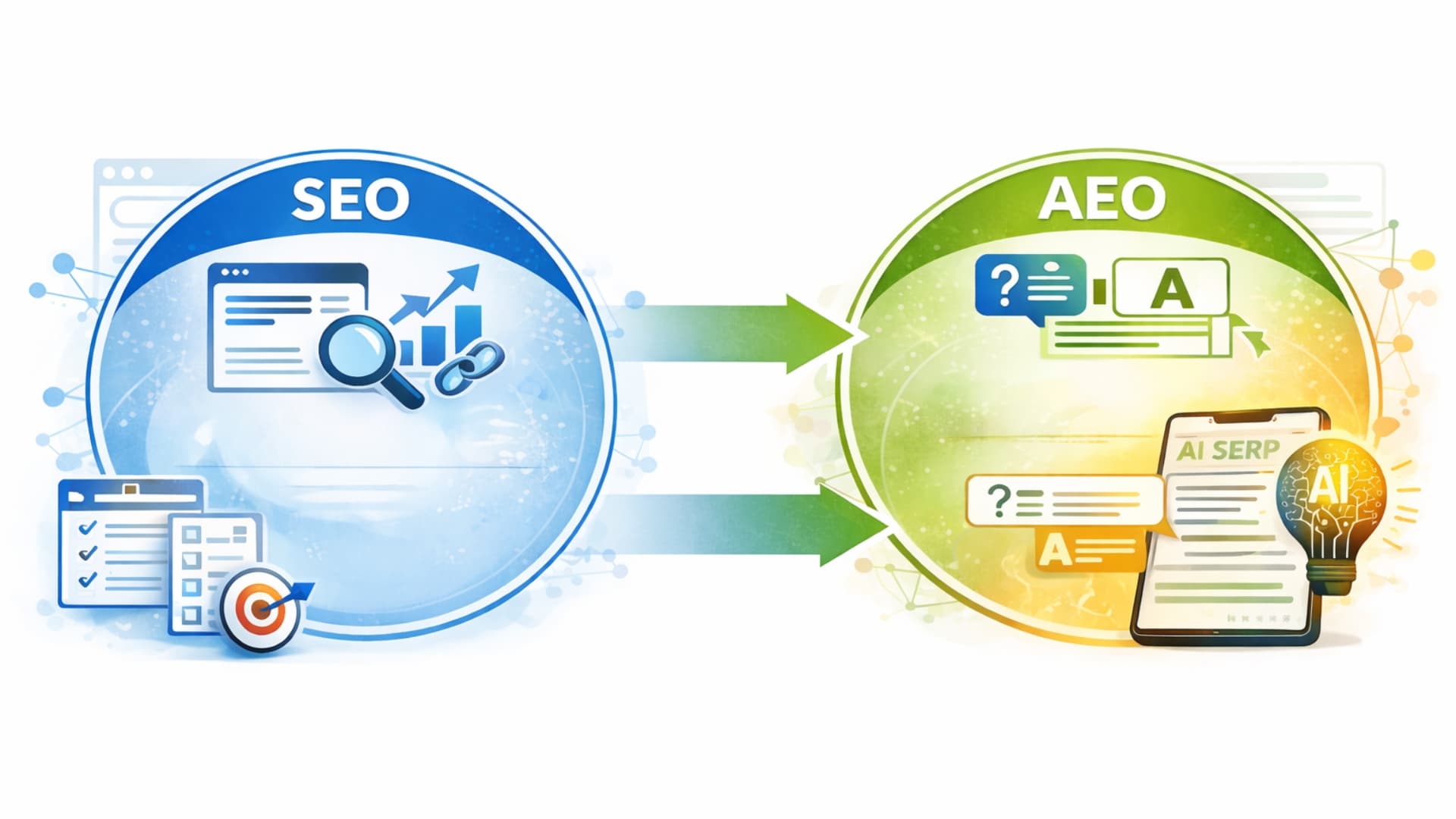
AEO (Answer Engine Optimization) differs from traditional SEO in one key aspect—and this difference is becoming increasingly noticeable. While SEO ensures that pages appear in organic search results and are clicked on, AEO focuses on making content itself become the answer.
This shift is directly linked to the growing use of AI in Google Search. With AI Overviews and generative search results, the way information is presented is changing: users often receive answers directly within the search results, without needing to visit a website. In a separate article, we explore in detail how Google’s AI-driven generative search is evolving and what this means for visibility.
Instead of evaluating entire pages, search engines and AI systems selectively extract individual text passages, lists, or concise explanations. For content to be considered in this context, it must be clearly structured, easy to understand, and technically well prepared. AEO does not replace SEO—it builds on it and extends it with an additional layer of visibility where clarity and contextual relevance are decisive.
What is GEO and what role does it play in comparison?
GEO (Generative Engine Optimization) targets a further stage of search—generative AI systems that do not merely display content but summarize it, contextualize it, and enrich it with sources. The primary goal here is less about providing a single answer and more about a key question: which sources are selected, referenced, and cited by AI systems at all?
Unlike AEO, GEO does not focus on a specific text passage but on the overall content trustworthiness of a website. AI systems tend to rely on sources that publish consistently on a topic over time, demonstrate subject-matter rigor, and are classified as credible.
As a result, thematic authority, clear positioning, and stable trust signals play a central role. At the same time, the same principle applies here: GEO does not replace SEO. Without solid technical foundations, structured content, and indexability, there is no basis for content to be considered by AI systems in the first place.
How are AI systems changing traditional SEO strategies?
AI systems are currently changing in very concrete ways how your content is selected and presented. The focus is no longer on whether a page ranks in position three or five, but on which individual statement, definition, or source is used at all. Visibility is increasingly created at the paragraph level—where content is precise, traceable, and citable.
Traditional SEO remains the foundation. It ensures that content is technically accessible, cleanly indexed, and thematically well structured. Without these fundamentals, content will not be considered in either search results or AI-generated answers.
At the same time, it is no longer sufficient to simply place keywords or build backlinks. AI systems increasingly decide for themselves which content they trust, which they formulate as answers, and which they cite as sources. In this context, clarity, subject-matter depth, and consistency matter far more than individual ranking signals.
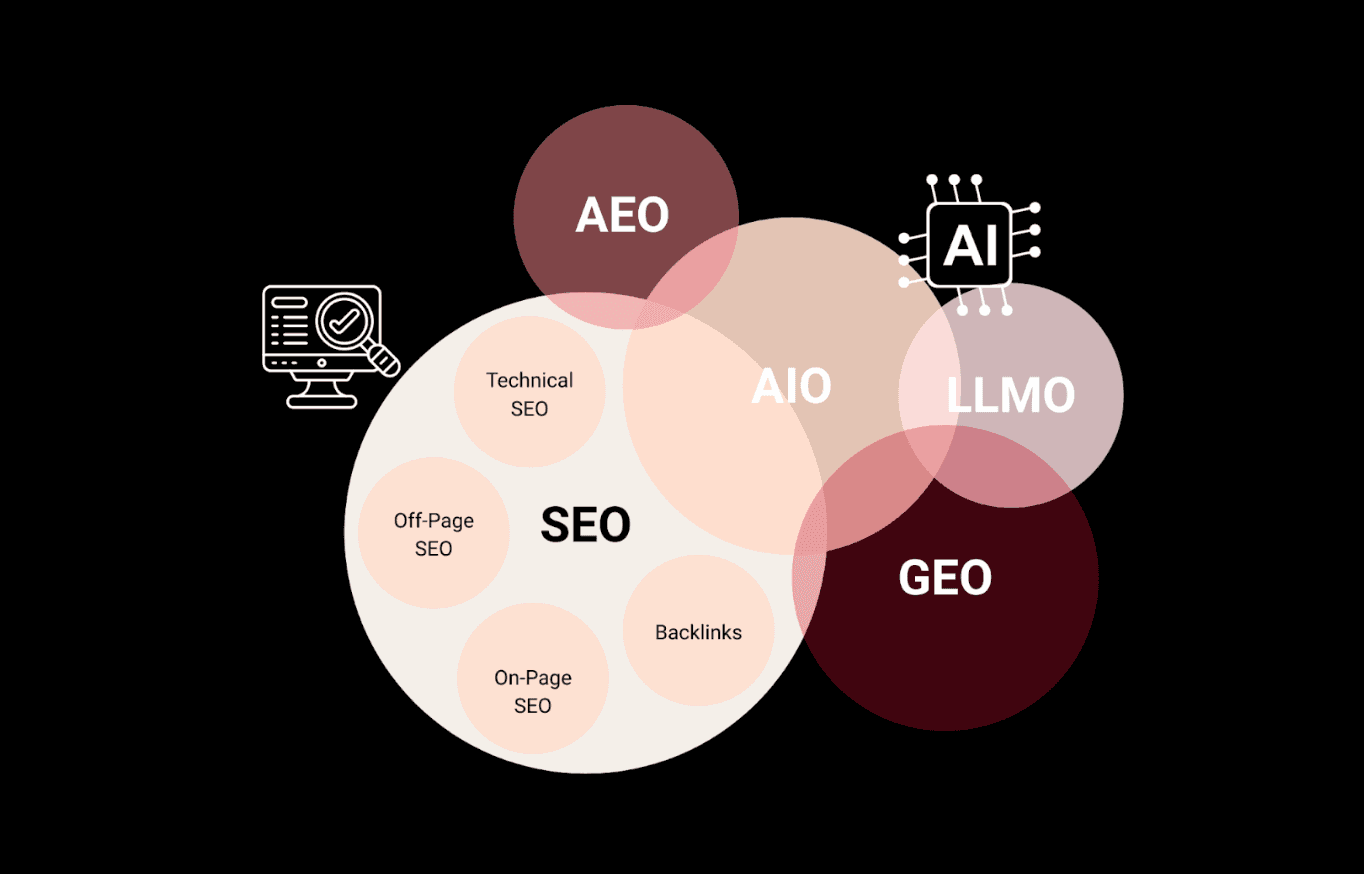
This is exactly where AEO and GEO come into play. AEO helps structure content so that it directly answers specific questions with precision. GEO ensures that your content is recognized as a relevant and authoritative source in generative summaries. Both disciplines rely on clear structure, semantic clarity, and genuine content substance.
For your content strategy, this means a shift in perspective: content must not only be found, but also understood, extracted, and cited. If you continue to optimize exclusively for rankings, you risk losing visibility in AI answers, voice search, and generative results.
Modern SEO strategies therefore integrate SEO, AEO, and GEO from the outset. This creates an approach that simultaneously addresses rankings, direct answers, and AI citations—securing long-term visibility in an increasingly AI-driven search environment.
Do I still need SEO if I focus on AEO or GEO?
Yes. SEO is the foundation of any modern optimization strategy. Without a clean technical setup, clear site structures, and reliably indexable content, neither AEO nor GEO can be effective.
At the same time, SEO no longer ends with rankings alone. AEO and GEO do not replace SEO—they build on it and extend it. Only a combined strategy that integrates rankings, direct answers, and AI citations creates sustainable visibility in an increasingly AI-driven search environment.
Which content formats benefit most from AEO and GEO?
Not every content format is equally suited for AEO and GEO. The formats that benefit most are those that address a clear information need and answer questions in a way that is easy to understand and further processed by AI systems.
For AEO, formats work best where users start with a specific question and expect a precise answer. These include guides, glossaries, explainer pages, and FAQ formats. Comparison articles and how-to content also offer strong potential because they are logically structured and clearly separate individual statements. This type of content can be easily extracted and integrated into AI answers or voice search results.
GEO goes one step further. Here, thought leadership pieces, expert articles, and in-depth analyses are particularly important. They help build topical authority and position your brand as a trustworthy source. The focus is not on delivering a quick answer, but on establishing long-term credibility as a competent voice on a subject.
Pure product pages or traditional landing pages usually play a secondary role in this context. While they may be important from an SEO perspective, they contribute only to a limited extent when it comes to being cited in AI answers or selected as a source.
Important: What matters is not content length, but content reliability. Content must provide clear answers or explain relationships—not merely present information.
What role does E-E-A-T play in the interaction between SEO, AEO, and GEO?
E-E-A-T—Experience, Expertise, Authoritativeness, and Trustworthiness— plays an even more critical role in an AI-driven search environment than it did before.
In traditional SEO, E-E-A-T already served as a useful quality signal. With AEO and GEO, however, it becomes a decisive filter that determines whether AI systems select and use content at all. When multiple potential answers are available, systems must decide which source to trust—and this is exactly where E-E-A-T comes into play.
For AEO, this means that answers must not only be correct but also perceived as reliable. AI models evaluate factors such as where the information comes from, who authored it, and how well it is supported by evidence. Content built on credible sources, transparent reasoning, and clear structure has a clear advantage here.
GEO goes one step further, as the goal is to be named or cited as a trustworthy source. Especially when generative search results display source references, it becomes evident how strongly trust influences visibility. Content that has built topical consistency and authority over time is far more likely to be selected.
In practical terms, this means:
well-developed author profiles with verifiable subject-matter expertise
clear, evidence-based statements instead of vague formulations
transparent structure and traceable sources
Trust therefore becomes more than a “nice to have”—it is a prerequisite for visibility in AI-generated answers. And this does not apply to content alone: technical and legal factors can also influence perceived trustworthiness. Accessibility, for example, plays an increasing role. We explore how regulatory frameworks such as the European Accessibility Act (EAA) affect website trust and perception in Switzerland in our dedicated article on the European Accessibility Act in Switzerland.
How does content planning change with AI-based search systems and the mix of SEO, AEO, and GEO?
AI-based search systems are changing how content is planned—and how content is conceived overall. Instead of working through individual keywords, the focus has shifted to questions, topical relationships, and usage contexts. Content is no longer evaluated solely at the page level but increasingly at the level of individual sections.
This has direct implications for content planning. Content must be structured in a more modular way: each paragraph should be understandable on its own and serve a clear purpose. Definitions, explanations, and key statements should be deliberately separated and logically placed so that both users and AI systems can clearly interpret them.
At the same time, editorial processes are evolving. Research, structure, and semantic consistency are becoming even more important. Content is no longer created exclusively for readers who consume an article in full, but also for systems that select, summarize, and cite information.
For content strategy, this means that SEO, AEO, and GEO must be considered together from the planning stage onward. Content that is structured to be discoverable, understandable, and citable from the outset lays the foundation for visibility—both in traditional search results and in AI-generated answers.
“SEO isn’t dying or changing course. Conversational AI gives people a new way to find answers. Search isn’t a channel, it’s an ecosystem. - Ric Rodriguez, Expert für SEO und AI-Search”
A future-ready search strategy?
Let’s talk about the interplay of SEO, AEO, and GEO over a coffee. Get in touch with us now for a no-obligation conversation.


Spannende Themen für dich!